What evidence do you need for a restraining order?
Published October 21, 2026 · Updated October 28, 2026
Short answer: less than most people fear, and more organised than most people bring. Your own sworn statement describing specific incidents with dates is evidence. Texts, call logs, voicemails, photos, police reports and witnesses support it. What persuades a judge is a clear pattern with dates, shown in a form that can be read in minutes and kept in the file.
This is general information. The exact rules depend on your state and on which kind of order you are asking for, and the court's self-help centre or a legal aid office can tell you what applies to you.
What the judge is deciding
Every state has one or more civil orders that go by names like domestic violence restraining order, order of protection, protective order, civil harassment order or anti-stalking order. The judge first decides whether to grant a temporary order, often the same day and on your papers alone, and then holds a hearing a few weeks later where the other person can answer. At that hearing the usual standard is "more likely than not", not the criminal "beyond reasonable doubt". The question is whether specific acts happened and whether an order is needed now.
Because the standard is what it is, a well-organised account of three or four dated incidents beats a thick folder of undated screenshots.
The kinds of evidence that count
- Your statement. The petition asks you to describe incidents, most recent first, with dates or approximate dates. This is sworn and it is evidence. Write short, factual paragraphs: what was said or done, when, where, who saw it, and what you did next.
- Messages. Text messages, iMessage, WhatsApp, Messenger, Instagram and Snapchat messages, and emails. The judge needs to see who sent each message and when, and enough of the surrounding conversation to show it is not taken out of context.
- Calls and voicemails. A call log showing dates, times and counts, and voicemails saved as audio files. Many courts want a written transcript of any recording alongside the file.
- Photos and video. Injuries, damage, the person outside your home, a car that keeps appearing. The date the photo was taken matters, so keep the originals; the capture date is lost when you text or screenshot a photo.
- Third-party records. Police reports and report numbers, medical records, a letter from a shelter or counsellor, a school's record of an incident.
- Witnesses. Anyone who saw or heard an incident, or saw you right after. They can come to the hearing or, in many courts, sign a declaration.
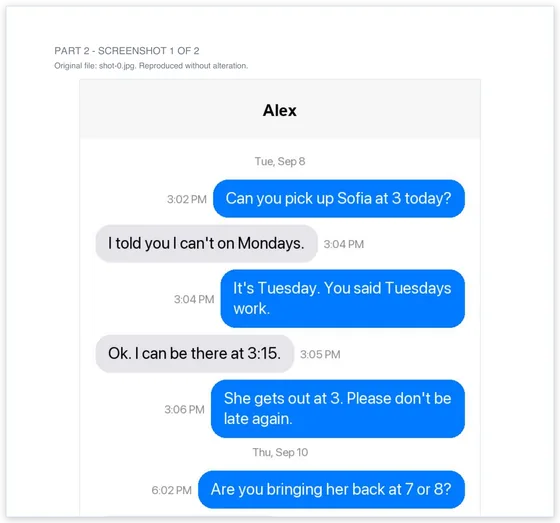
Can you pick up Sofia at 3 today?
I told you I can't on Tuesdays.
How much is enough
There is no number. A single serious threat with a screenshot and a police report can be enough. So can a pattern of forty unwanted contacts after you asked the person to stop, if the contacts are dated and the request to stop is in the record. What is rarely enough is a general description with no dates and no documents, or a stack of screenshots that the judge would have to sort into order on the bench.
Recency matters too. Courts look for a reason to act now, so lead with the most recent incident and show how it fits the earlier ones.
Preparing the messages
Courts handle this differently, but almost all want paper or a PDF, not your phone. The common instruction is three copies: one for the judge, one for the other side, one for you. For messages that means printing them in order, with sender, date and time visible on every one, numbered so you can point to "message 14" when you testify.
If you have a long thread as screenshots, the problem is order and overlap: dozens of images that repeat each other at the edges and lose their dates. Court Texts reads screenshots into a numbered, dated transcript and attaches every original screenshot as a labelled exhibit, which is the form judges find easiest to read. Whichever way you do it, keep the original screenshots and the phone; the court can ask to see them.
What weakens a petition
- Screenshots that have been cropped to remove your own messages. Show the whole exchange; the judge will assume the worst about what was cut.
- Undated photos and messages. If a date is not visible, add it in your statement and say how you know it.
- Exaggeration. One inaccurate claim the other side can disprove makes the judge doubt the accurate ones.
- Bringing it on your phone. Many judges will not take a phone from a party, and a hearing is not the time to scroll.
Where to check your state's rules
Each state's court system publishes the forms and a guide. California's self-help site covers domestic violence and civil harassment orders; Illinois Legal Aid Online covers orders of protection; New York's court site covers family court orders of protection; Texas Law Help covers protective orders. A domestic violence advocate or legal aid office can help you prepare the petition for free in most places.
Common questions
Do I need a police report to get a restraining order?
No. A report helps and the judge will usually want to know whether you made one, but orders are granted every day on the petitioner's statement and messages alone.
Can screenshots be used as evidence for a restraining order?
Yes, and they are the most common evidence in these hearings. They need to show who sent each message and when, in order, with your side of the conversation included. See our guide on whether screenshots can be used in court.
Will the other person see my evidence?
At the hearing, yes. Anything you give the judge is given to the other side too. Your address can usually be kept confidential; ask the clerk.
What if the messages were deleted?
If you deleted them, a carrier can confirm that messages were exchanged with a number but not their content. If the other person deleted them, your copies are still evidence. Screenshots you took at the time are fine.
Turn your screenshots into a transcript PDF for court →More guides: Print texts for court from an iPhone · Print texts for court from Android · Can screenshots be used in court? · How to organize screenshots for court · How to get a transcript of text messages · Print WhatsApp messages for court · How to authenticate text messages for court · Turn text messages into a PDF · How to prepare text messages for court · Best way to get text messages for court · Can text messages be used in court? · Are text messages admissible in court? · Decipher TextMessage or iMazing for court? · TextExhibit alternatives for court · iMazing alternatives for printing texts for court · Decipher TextMessage alternatives · SMS Backup & Restore to a court PDF · Can you get text message records from your carrier? · Print Messenger, Instagram or Snapchat messages for court · ThreadProof vs Court Texts · How to submit evidence in family court · Best apps to print text messages for court · How to save a text conversation · How to send a text conversation to email